Mother bear with 2 cubs is shot dead, sparking outrage in Italy_我的网站
A | The slaying of an endangered brown bear near an Italian national park left her two young cubs motherless and sparked outrage in Italy on Friday.Italy's environment minister and animal rights advocates voiced anger and dismay over the killing of the bear in the mountainous Abruzzo region. Local residents, including families with small children, had often stopped to watch the bear and her cubs during the animal family's frequent evening excursions through streets near the park.A bear named Amarena crosses a street with her cubs in front of a group of people, in San Sebastiano Dei Marsi, Abruzzo, Italy, August 26, 2023 in this still image from video obtained from social media. Gemma Di Pietro/via REUTERS The National Park of Abruzzo, Lazio and Molise described the slain animal, nicknamed Amarena — or Black Cherry in Italian — as one of its most prolific brown bears. Residents coined the name because cherries and black cherries were among the bear's favorite foods, the Corriere della Sera newspaper said. The park posted a graphic image of the bear lying dead on the ground.The man who shot the bear with a rifle Thursday night in the town of San Benedetto dei Marsi told police the animal was on his property and he felt in danger, the Italian news agency ANSA said.
"I shot out of fear, but I didn't want to kill. I found her inside my property and it was an impulsive, instinctive act," he was quoted as saying by ANSA, the BBC reported.Park director Luciano Sammarone told ANSA that the bear had crossed a private fence. "However, I'm struggling to believe this was a matter of self-defense," Sammarone told the news agency, adding that he would reserve judgment until the investigation is complete.Prosecutors were looking into a possible charge of animal killing, and police took the rifle, which was legally owned by the 56-year-old man, as part of their investigation, the LaPresse news agency said.
The marsican brown bear, endemic to central Italy, is considered at an elevated risk of extinction. The park says about 60 bears live within the park or in its surrounding areas."The killing of a marsican female bear is a grave episode, on which it's dutiful to shed light as quickly as possible,'' Environment Minister Gilberto Pichetto said."Our commitment is aimed also at the protection of the bear's cubs, doing everything possible so that they can remain free,'' he said in a statement.Drones were being used in the search for the cubs, LaPresse said.The head of World Wildlife Fund's Italy office, Luciano Di Tizio, called the bear's slaying a "very grave, unjustifiable crime of nature" and the result of a "constant campaign against wildlife."The motherless cubs aren't yet self-sufficient and thus are at high risk, triggering the search for them in the parklands, he added."A self-assured, but completely peaceful bear, Amarena was part of the collective imagination and was the subject of pride in a land that has, in the bear, a symbol" of local nature, Di Tizio said.
The theme of bear vs. humans has taken on political connotations in Italy and landed in the courts. Earlier this year, an administrative court's ruling spared, for now, the life of a brown bear that fatally attacked a runner on a mountain trail in Italy's Alpine region.Local political authorities had issued an order to have the 17-year-old female bear, known as Jj4, euthanized. A court hearing on the bear's fate is expected in December. Animal rights groups have challenged the order to put down the bear.The brown marsican bear which was killed on Thursday is a subspecies that is genetically different from alpine bears.Italian state TV said Friday that Amarena was the mother of another one of the park's bears that met a violent end. That bear, which was fatally struck by a car earlier this year, earned national fame when it broke into a bakery and munched on cookies.
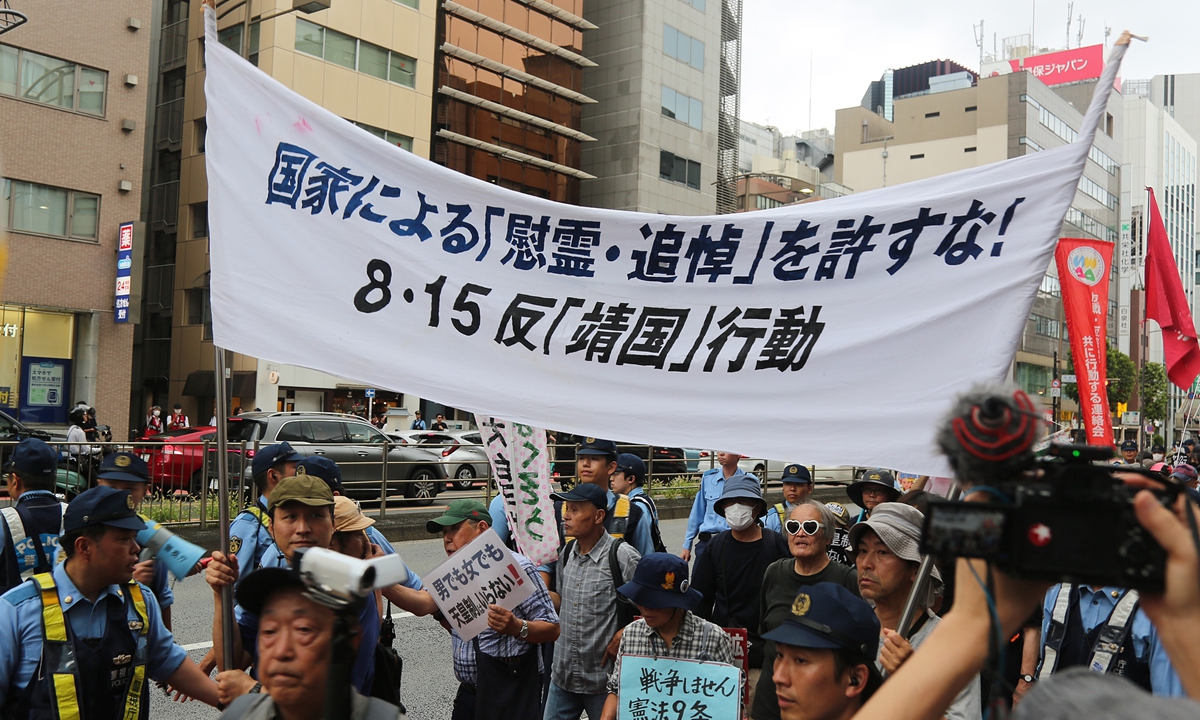
Japanese citizens hold a protest march near Awaji Park in Tokyo on August 15, 2026, opposing politicians offering ritual fees to or visiting the notorious Yasukuni Shrine, which enshrines Class-A war criminals from World War II. Photo: VCG Against the backdrop of strong opposition from China and South Korea, another senior official from Japan's ruling Liberal Democratic Party (LDP) visited the notorious Yasukuni Shrine on Sunday, following a string of visits by senior party figures the previous day on the 81st anniversary of Japan's unconditional surrender in World War II. Their handling of the Yasukuni Shrine issue, Chinese observers said, served as a revealing "mirror," laying bare the growing influence of far-right ideology in Japanese society and its gradual emergence into the mainstream to piece together the picture of neo-militarism, while broader political and security moves under the current government point to a gradual erosion of Japan's postwar pacifist constraints and a drift toward neo-militarism. Rampant far-right sentiment According to Japanese media outlet The Mainichi, Takayuki Kobayashi, a senior executive of Japan's ruling LDP, visited the war-linked Yasukuni shrine on Sunday. One day before his visit, a total of four Cabinet ministers visited the shrine, along with three top ruling party executives - Secretary General Shunichi Suzuki, General Council Chair Haruko Arimura and election strategy chief Yasutoshi Nishimura, per the report. Although Prime Minister Sanae Takaichi did not visit the shrine, she made a "tamagushi" ritual offering to the war-linked shrine in her capacity as president of the LDP. Takaichi also performed a remote act of worship toward the notorious Yasukuni Shrine, a symbol of the country's militarism and wartime aggression, from nearby instead of visiting in person, according to the Xinhua News Agency. The shrine, located in central Tokyo's Chiyoda Ward, honors 14 convicted Class-A Japanese war criminals from World War II. For a long time, visits and ritual offerings made by Japanese officials to the controversial shrine have consistently sparked criticism and opposition both at home and abroad. The visits drew immediate and firm opposition from China and South Korea on Saturday. China's Foreign Ministry, Ministry of National Defense and the Chinese Embassy have all voiced their objections. "We urge the Japanese side to do serious soul-searching on its history of aggression, make a clean break with militarism, and earn trust from its Asian neighbors and the rest of the world with concrete actions," a Chinese Foreign Ministry spokesperson said in a statement on Saturday. South Korea also denounced visits by Japanese officials and politicians, urging Japan's leaders to squarely face history and show remorse in order to develop bilateral relations based on mutual trust, South Korean media Yonhap News Agency reported on Saturday. Kim Hak-jo, director general for international policy at South Korea's defense ministry, summoned Takeshi Nagayoshi, Japan's defense attache in Seoul, to the ministry headquarters and lodged a strong protest over Japanese Defense Minister Shinjiro Koizumi's visit to the shrine, the ministry said, per Yonhap. Despite the criticism, Kobayashi said he visited the shrine as a "family member," noting that his grandfather had died in the war, according to the Mainichi. Lü Chao, a professor at the Liaoning Academy of Social Sciences, told the Global Times on Sunday that Takaichi's move signaled "tolerance" of such visits. Even without visiting the shrine in person, Takaichi performed a ritualized act of worship toward it from nearby, which Lü said exposed her deeply entrenched position. The episode also serves as a "mirror," laying bare the political attitudes of Japanese politicians and their views on war and history, Lü said. Looking at the visits by successive Japanese cabinets in past years, former prime minister Shigeru Ishiba at least expressed remorse over the war, whereas the current government has become more hardline. This shows that far-right sentiment in Japan is becoming increasingly widespread and is gradually moving into the mainstream, he continued. "Japan is piecing together the picture of neo-militarism. The international community should remain alert to the risk of Japanese militarism's resurgence," the expert added. Also on Saturday, Takaichi attended her first war memorial ceremony since taking office last year. In her speech, Takaichi pledged peace but she fell short of using the words employed at last year's memorial by her predecessor Ishiba, who vowed to keep in mind Japan's "remorse" over the war and expressed its "resolute pledge to renounce war," Japanese media Kyodo News reported. Before the late Shinzo Abe, Takaichi's "political mentor," took office as prime minister for the second time in December 2012, Japanese leaders had consistently mentioned the nation's aggression and expressed remorse at the ceremony, per Kyodo News. Takaichi's remarks seek to balance Japan's established national position with her own political interests and those of her party, Lian Degui, director of the Center for Japanese Studies at Shanghai International Studies University, told the Global Times on Sunday. As a representative of the right wing in Japan, Takaichi herself does not advocate deeper reflection on Japan's wartime past, but she also faces constraints from opposing political forces at home. Her deliberate avoidance of terms such as "remorse" therefore reflects her personal political stance, while also serving as a compromise between competing forces on Japan's political spectrum, Lian added. Takaichi has adopted similarly ambiguous language on other sensitive security issues. At memorial ceremonies in Hiroshima and Nagasaki earlier this month, Takaichi said Japan currently maintains its Three Non-Nuclear Principles but stopped short of explicitly committing her government to keeping all three principles in the future. Lian added that offering ambiguous remarks could also be seen as a move designed to leave room for policy debates over possible revisions to national security documents and related principles by year end. "As long as right-wing forces remain in power, Japan will continue drifting toward neo-militarism through a gradual and sustained erosion of the constraints imposed by its pacifist Constitution," Lian said. Underlying strategic anxiety In Takaichi's speech on Saturday, she also claimed that her country could become "a shining beacon in the 'Indo-Pacific' that others could rely on." The Japan Times reported on Saturday that her inclusion of the term "Indo-Pacific" likewise brought her foreign-policy agenda into the memorial message. In an effort to curry favor with Washington, Japan has sought to portray itself as a leading force in containing China's rise. Yet such ambitions clearly overstate Japan's own capabilities and amount to little more than strategic overreach, as the gap between Japan and China in terms of overall national strength remains substantial, the expert said. Takaichi's decision to invoke its so-called "Indo-Pacific strategy" on a sensitive historical anniversary only further exposes her administration's strategic anxiety and uncertainty in the face of China's rise, Lian added. 。
B |
Current article:http://g6jga.nenyaogecebenliexi.shop/news/20260826_8563430.html